
Famous Medal Of Honor Recipients Who Are Army Soldiers: History and Evolution
Some of the most famous Medal of Honor recipients who are Army soldiers in American history include Sgt. Alvin C. York, SSG Salvatore Giunta, SSG Clinton Romesha, SSG Ty Carter, SFC Jared Monti, Gen. Richard Cavazos, and Col. Ralph Puckett — each honored for acts of extraordinary valor above and beyond the call of duty.
Here is a quick overview of these seven recipients:
| Recipient | Conflict | Key Action |
|---|---|---|
| Sgt. Alvin C. York | World War I | Captured 132 enemy soldiers single-handedly |
| Pvt. Shinyei Nakamine | World War II | Neutralized multiple German machine-gun nests |
| Gen. Richard E. Cavazos | Korean War | Rescued 5 wounded soldiers under heavy fire |
| Spc. Kenneth J. David | Vietnam War | Drew enemy fire to protect wounded comrades |
| SSG Salvatore A. Giunta | Afghanistan | Stopped capture of a wounded soldier during ambush |
| SSG Clinton L. Romesha | Afghanistan | Led counterattack against 300 Taliban fighters |
| SSG Ty Michael Carter | Afghanistan | Crossed open ground under fire to rescue a wounded soldier |
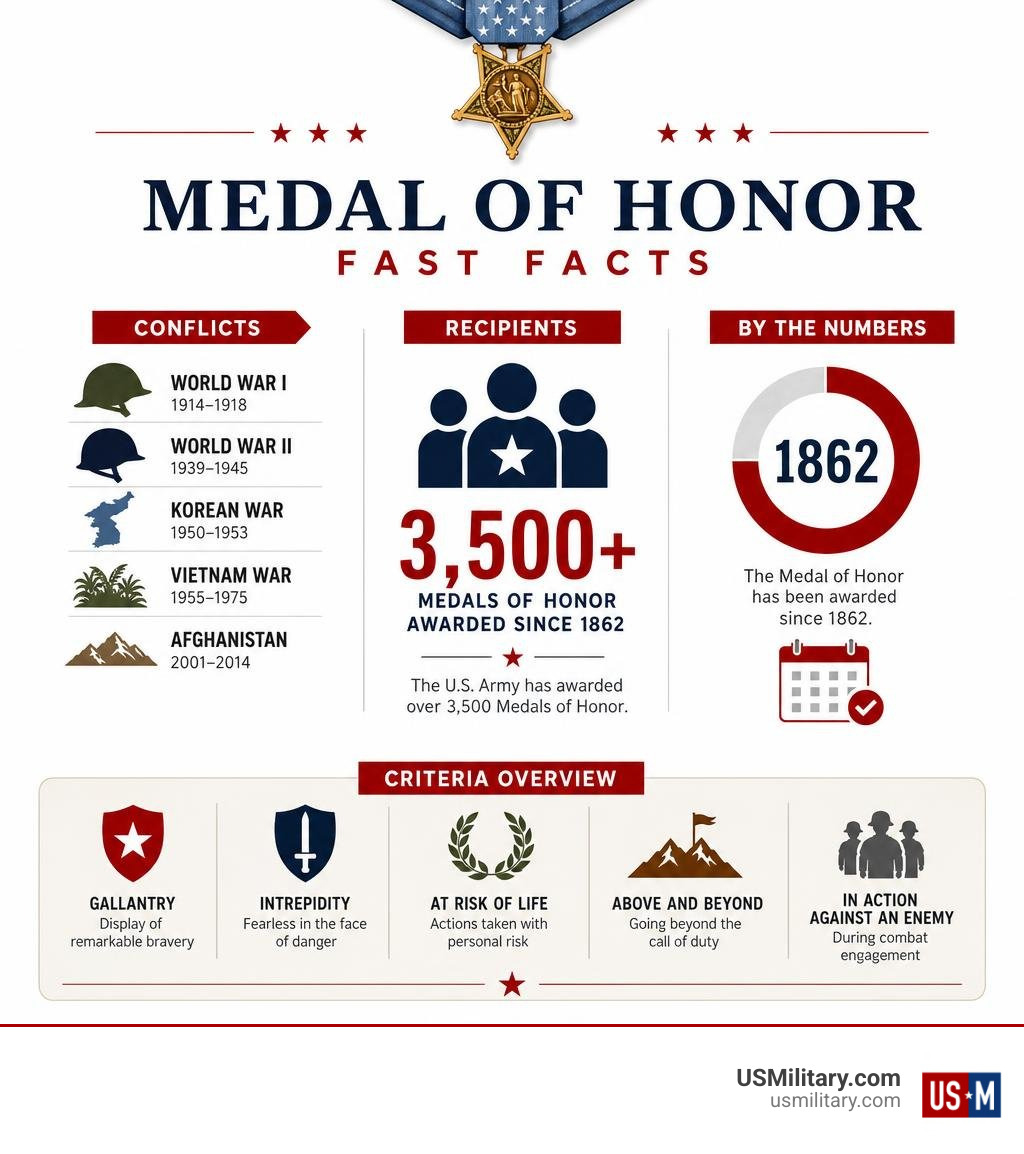
The Medal of Honor is the United States military’s highest award for combat valor. To earn it, a service member must distinguish themselves conspicuously — by gallantry and intrepidity, at the risk of their own life — above and beyond the call of duty, in action against an enemy.
President Harry Truman, a World War I veteran himself, once told a group of Medal of Honor recipients: “I would rather have this medal than be president.”
Since 1862, the U.S. Army has awarded over 3,500 Medals of Honor. The bar is extraordinarily high. Many recipients never lived to receive it.
I’m Larry Fowler, publisher of USArmy.com & USMilitary.com, and since 2007 I’ve spent nearly two decades helping active-duty service members, veterans, and military families navigate their benefits, careers, and military history — including the stories of famous Medal of Honor recipients who are Army soldiers. In the sections below, I’ll walk you through seven of the most remarkable recipients and what made their actions unforgettable.
Famous Medal Of Honor Recipients Who Are Army Soldiers glossary:
- How Massive is the US Military
- What is the Department of War
- What is the Army new helicopter S-97 Raider
To truly appreciate the stories of famous Medal of Honor recipients who are Army soldiers, we must first understand how this legendary decoration came to be.
The Medal of Honor was born during the dark days of the American Civil War. In December 1861, President Abraham Lincoln signed Public Resolution 82 to establish a Navy version of the medal. Just a few months later, in February 1862, Congress authorized the Army Medal of Honor. It was a step; before this, the United States did not have a permanent, high-level decoration for individual combat bravery.
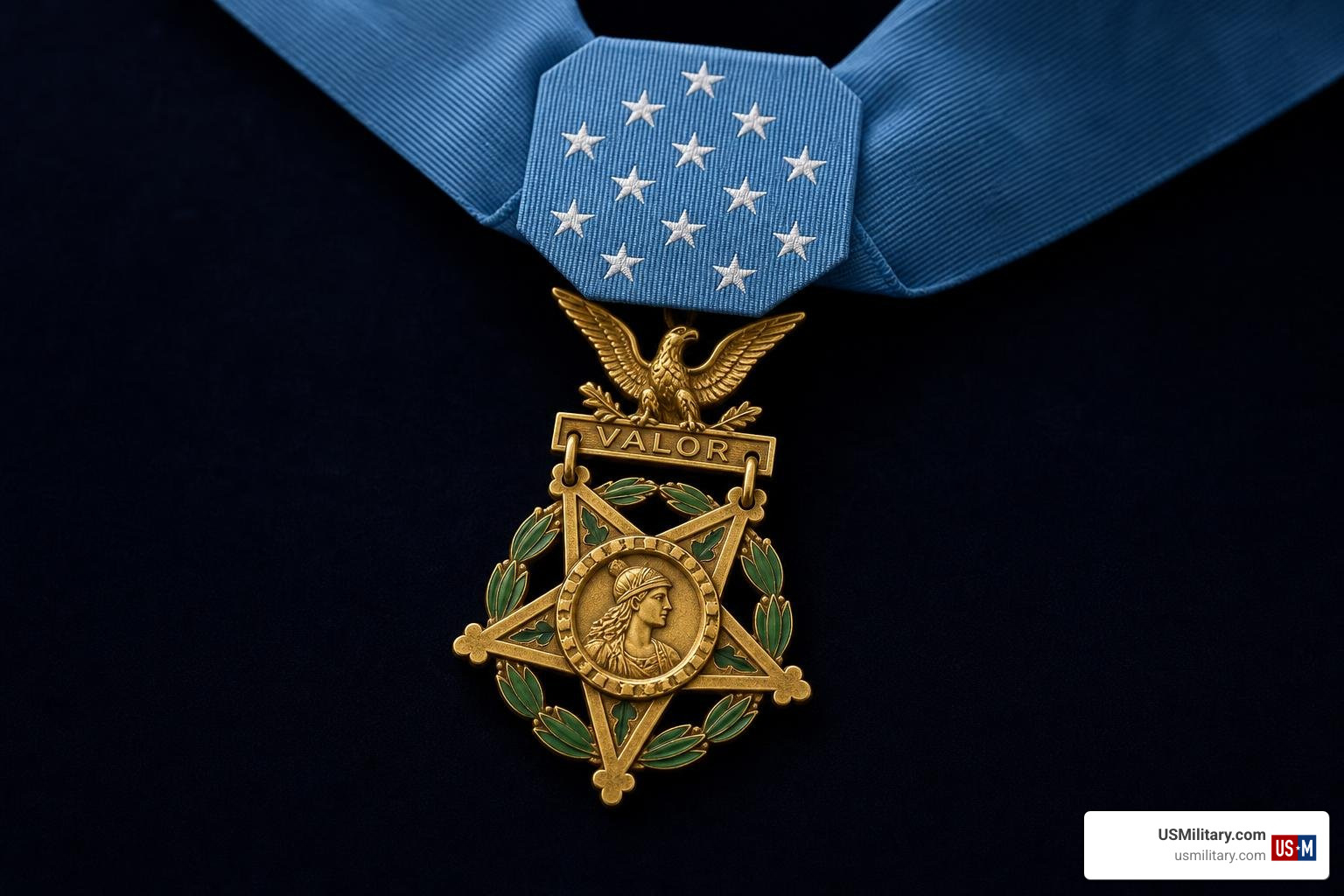
The physical design of the Army version has its own beautiful story. It was designed by a Civil War recipient, General George Gillespie. The medal features the Roman goddess Minerva—symbolizing wisdom and righteous war—standing in the center of a five-pointed star. She is surrounded by a green laurel wreath representing victory and oak leaves representing strength. The star is connected to a light blue ribbon featuring 13 white stars (representing the original colonies) by a bald eagle perching on a gold bar inscribed with the word “VALOR.”
How the Medal of Honor Designs Differ
While all branches of service share the same blue ribbon, the physical medals themselves vary significantly. We can compare the designs in the table below:
| Feature | Army Version | Navy/Marine Corps Version | Air Force Version |
|---|---|---|---|
| Central Figure | Minerva (Goddess of Wisdom/War) | Columbia (Defeating Discord) | Valorous Star (No central goddess) |
| Surrounding Elements | Green laurel wreath & oak leaves | Anchor & laurel leaves | Laurel wreath & thunderbolts |
| Suspension Device | Bald eagle on a “VALOR” bar | Anchor | Thunderbolt & eagle wings |
Over the decades, the process for awarding the Medal of Honor has evolved dramatically. In the early days, the standards were somewhat different. For instance, during the Civil War, the medal was the only military award available, meaning it was sometimes given for actions that today might receive a Silver Star or Bronze Star.
To protect the prestige of the nation’s highest honor, a strict review board in 1916 rescinded 911 Medals of Honor that had been awarded to non-combatants or civilians. Then, a July 1918 Act of Congress officially established “lesser” awards (such as the Distinguished Service Cross and Silver Star). This legislative shift elevated the Medal of Honor to its modern, ultra-exclusive status, restricting it strictly to actions involving actual conflict with an enemy “above and beyond the call of duty.”
Evolving Standards: Combat, Race, and Ethnicity
The evolution of the medal also reflects America’s journey toward correcting historical injustices. For decades, systemic prejudice and administrative hurdles prevented minority service members from receiving the recognition they deserved.
In recent decades, we have seen major efforts to review historical records. This led to events like “Valor 24” in March 2014, where 24 Army veterans from World War II, Korea, and Vietnam received retroactive upgrades to the Medal of Honor. Over two dozen Medals of Honor have been retroactively awarded to Black, Asian-American, Hispanic, and Jewish soldiers whose original recommendations were downgraded due to discrimination.
When we read the official citations of these soldiers, certain words and themes appear repeatedly. Words like gallantry, intrepidity, selflessness, and conspicuous bravery form the backbone of these records. The citations read like a roll call of the ultimate human sacrifice.
The 7 Famous Army Medal of Honor Recipients You Should Know
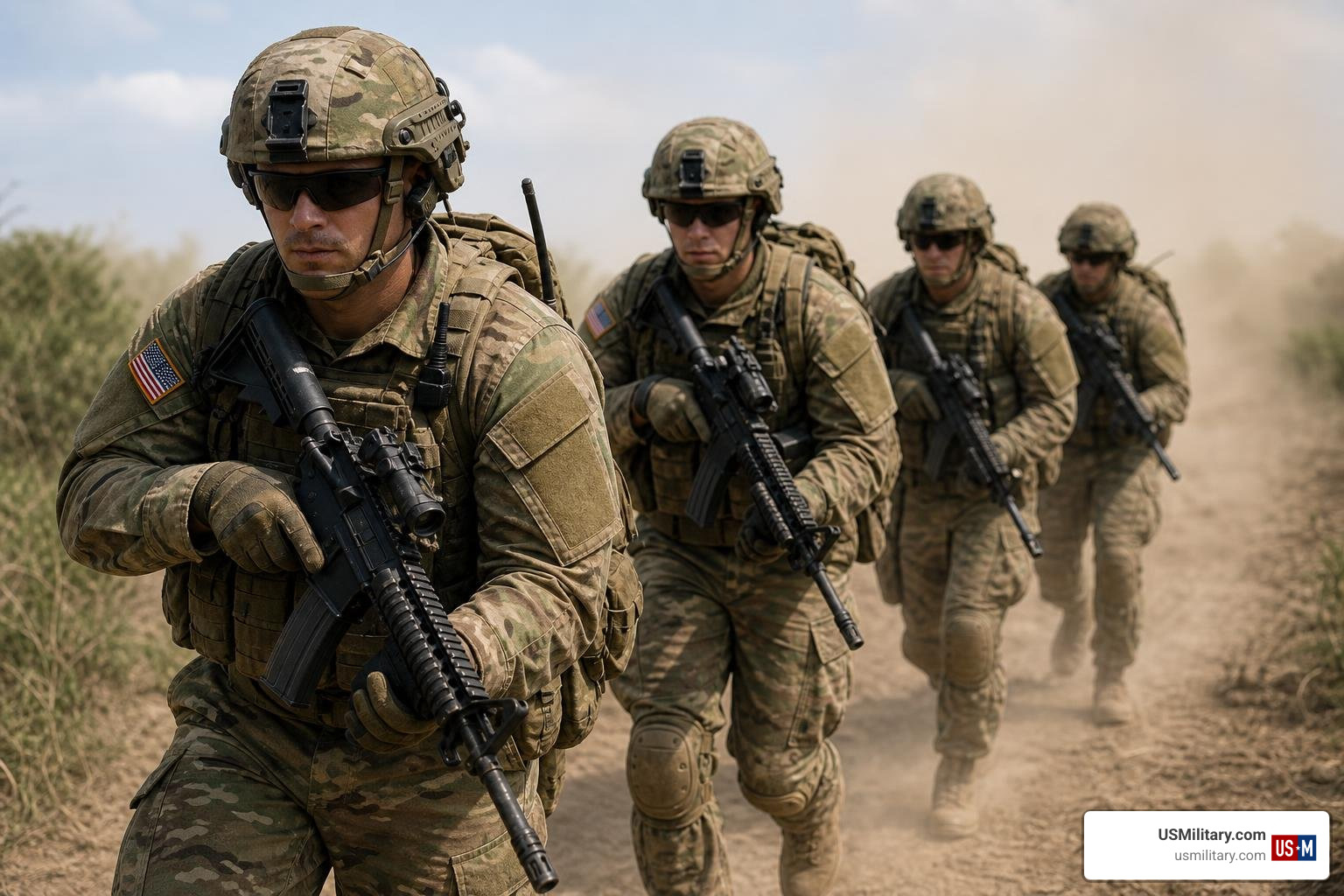
The legacy of the U.S. Army is built upon the courage of individual soldiers. Among the most legendary units is the 1st Infantry Division—famously known as the “Big Red One.” As the first American division sent to Europe in both World War I and World War II, the Big Red One has earned a staggering share of valor awards.
Out of 119 Medals of Honor awarded in WWI, 1st Infantry Division soldiers received five. In WWII, out of 434 total awards, Big Red One soldiers received 17 (nine posthumously). During the Vietnam War, they received 12 (10 posthumously). In the Global War on Terror, they received two—one posthumously to Specialist Ross A. McGinnis, and one to living recipient Staff Sergeant David Bellavia.
Whether they survived their incredible trials or made the ultimate sacrifice, these soldiers have left an indelible mark on our military heritage. Let’s dive into the lives of seven famous recipients.
Legendary Historical Famous Medal Of Honor Recipients Who Are Army Soldiers
1. Sgt. Alvin C. York (World War I)
Sergeant Alvin Cullum York is perhaps the most famous American soldier of World War I. Born in the rural hills of Pall Mall, Tennessee, York grew up as an expert marksman. However, following a deep spiritual conversion in 1914, he joined a pacifist church and initially sought conscientious objector status when drafted. After long, soul-searching discussions with his commanders during training, York reconciled his Christian faith with his duty to defend freedom.
On October 8, 1918, during the brutal Meuse-Argonne Offensive, York’s small patrol was pinned down by a devastating German machine-gun nest. With his superior officers and fellow soldiers killed or wounded, York took command. Relying on his sharp-shooting skills, he single-handedly silenced multiple machine-gun positions and captured 132 German soldiers.
True to his humble character, York refused to profit from his battlefield fame. He accepted only modest movie royalties—just enough to install indoor plumbing in his family’s farmhouse—and directed the rest of his wealth to building the Alvin C. York Agricultural Institute to provide rural education for mountain children.
2. Pvt. Shinyei Nakamine (World War II)
Private Shinyei Nakamine was a Japanese-American (Nisei) soldier serving in the legendary 100th Infantry Battalion—often called the “Purple Heart Battalion.” During World War II, Nisei soldiers fought with a fierce “Go For Broke” spirit, even as many of their families were held in internment camps back home.
On June 2, 1944, near La Torreto, Italy, Nakamine’s platoon was pinned down by intense German machine-gun fire. Acting on his own initiative, Nakamine crawled within 25 yards of the first enemy nest, neutralized it with submachine-gun fire, and captured two enemy soldiers. Later that afternoon, he led a charge against a second position, wounding one and capturing four more. He was tragically killed while attacking a third machine-gun nest.
Due to historical prejudices, Nakamine’s family had to wait over 50 years for his Distinguished Service Cross to be upgraded. In June 2000, President Bill Clinton posthumously presented the Medal of Honor to Nakamine’s sister, Anita Korenaga, finally cementing his place in history.
3. Gen. Richard E. Cavazos (Korean War)
Before he made history as the U.S. Army’s first Hispanic four-star general, General Richard E. Cavazos | Medal of Honor Recipient | U.S. Army was a young lieutenant leading the 65th Infantry Regiment—the historic “Borinqueneers”—during the Korean War. The unit was primarily composed of Spanish-speaking soldiers from Puerto Rico. Cavazos’ bilingual upbringing allowed him to lead them with clear, decisive communication, eliminating the confusion caused by previous non-Spanish-speaking commanders.
On June 14–15, 1953, near Sagimak, Korea, Cavazos led his company in multiple assaults on a heavily fortified enemy outpost. When ordered to withdraw, Cavazos refused to leave his men behind. He remained alone on the active battlefield under heavy fire to search for missing soldiers, personally executing multiple solo trips to evacuate five severely wounded men to safety.
Cavazos went on to serve heroically in the Vietnam War, where he was known for fighting on the ground alongside his troops rather than directing battles from a helicopter. His extraordinary career culminated in his promotion to Four-Star General in 1982, and his family accepted his upgraded Medal of Honor in early 2025.
4. Spc. Kenneth J. David (Vietnam War)
Specialist Fourth Class Kenneth J. David | Medal of Honor Recipient | U.S. Army was a drafted Eagle Scout from Ohio who served as an Indirect Fire Crewman and radio-telephone operator with the 101st Airborne Division in Vietnam.
On May 7, 1970, during a fierce battle at Fire Support Base (FSB) Maureen in Thua Thien Province, David’s unit was heavily attacked by a massive hostile force. When his platoon leader was mortally wounded, David handed off his radio, rushed to the defensive perimeter, and unleashed intense automatic fire.
Despite being wounded by an exploding satchel charge, David repeatedly exposed himself to direct enemy fire, jumping up and shouting to draw the enemy’s attention away from wounded comrades who were being gathered for medical evacuation. He refused medical aid for himself, telling the medic to focus on other casualties. Originally awarded the Distinguished Service Cross, his award was upgraded to the Medal of Honor in a ceremony scheduled by President Joe Biden in January 2025.
Modern Era Famous Medal Of Honor Recipients Who Are Army Soldiers
5. SSG Salvatore A. Giunta (War in Afghanistan)
Staff Sergeant Salvatore A. Giunta | Medal of Honor Recipient | U.S. Army became a household name when he was named the first living recipient of the Medal of Honor since the Vietnam War.
On October 25, 2007, during a brutal L-shaped ambush by 10 to 15 insurgents in the Korengal Valley of Afghanistan, Giunta’s squad was split and pinned down under a wall of RPG and machine-gun fire. Giunta immediately ran through active gunfire to drag his squad leader to safety after a bullet struck the leader’s helmet.
While advancing, Giunta was struck twice—one bullet hit his chest plate, and another destroyed a rocket launcher carried on his back. Ignoring his injuries, he charged forward alone, neutralized one insurgent, and forced another to flee, successfully preventing the capture of his severely wounded brother-in-arms, Sergeant Joshua Brennan. Giunta has remained incredibly humble, insisting that the medal belongs to his entire unit and describing the day of the ambush as “one of the worst days of my life” due to the comrades they lost.
6. SSG Clinton L. Romesha (War in Afghanistan)
On October 3, 2009, Combat Outpost (COP) Keating—situated at the bottom of a tight, bowl-shaped valley in Afghanistan—was attacked by over 300 Taliban fighters firing down from the high ground on all four sides. Staff Sergeant Clinton L. Romesha | Medal of Honor Recipient | U.S. Army was one of the key leaders who organized the defense of the outpost during the 13-hour battle.
Romesha displayed incredible tactical skill, using an Afghan National Army sniper rifle to neutralize multiple enemy positions. Despite being wounded by shrapnel, he directed air support and led a small team across 100 meters of open, intense fire to recover the bodies of fallen American soldiers, preventing them from falling into enemy hands. Romesha personally accounted for over 10 enemy casualties and coordinated strikes that eliminated dozens more. He later transitioned his risk-mitigation skills into a civilian career as an oilfield safety specialist.
7. SSG Ty Michael Carter (War in Afghanistan)
Staff Sergeant Ty Michael Carter | Medal of Honor Recipient | U.S. Army also fought at the Battle of COP Keating alongside Romesha. Carter, who originally served in the Marine Corps before enlisting in the Army as a Cavalry Scout, displayed extraordinary individual bravery under siege.
With the outpost burning and surrounded, Carter ran 100 meters across open ground under heavy fire to deliver ammunition to his pinned-down comrades. When their primary ammunition ran low, he and his team delinked M249 squad automatic weapon rounds to fire in their M4 rifles.
Carter then braved the gunfire again to rescue Specialist Stephan Mace, carrying the critically wounded soldier to the safety of a damaged Humvee while under direct targeting. Carter’s survival and subsequent advocacy for post-traumatic stress recovery have made him one of the most respected modern veterans in the country.
Special Operations and Recent Army Medal of Honor Recipients (2021–2026)
The elite soldiers of the U.S. Army Special Operations Command (USASOC) live by the Latin motto Sine Pari—”Without Equal.” These warriors face unique, highly complex challenges, often operating deep behind enemy lines with minimal support.
Among the most famous Special Operations recipients are Delta Force snipers Master Sergeant Gary I. Gordon and Sergeant First Class Randall D. Shughart. During the Battle of Mogadishu in October 1993, they repeatedly requested insertion into a hot crash site to protect the survivors of a downed Black Hawk helicopter. Armed only with sniper rifles and pistols, they fought off an overwhelming force of armed militia, sacrificing their lives to save pilot Michael Durant. They remain the only snipers in U.S. military history to receive the Medal of Honor.
Another legendary Special Operations story is that of Sergeant First Class Sergeant First Class Jared C. Monti | Medal of Honor Recipient | U.S. Army, a Fire Support Specialist (13F) with the 10th Mountain Division. On June 21, 2006, during Operation Gowardesh Thrust in Afghanistan, Monti’s 16-man patrol was ambushed on Mountain 2610 by approximately 50 enemy fighters.
Monti successfully called in danger-close artillery and used an inert grenade to trick and scatter advancing fighters. When one of his soldiers, Private First Class Brian Bradbury, was left wounded in the open, Monti made three separate, highly exposed attempts to rescue him, ultimately losing his life on the third attempt.
Recent Recipients (2021–2026)
As we look at the period from 2021 to the current year of 2026, several remarkable upgrades and new awards have occurred:
- Colonel Ralph Puckett (2021): A legendary Ranger who led the 8th Ranger Company during the Battle of Hill 205 in November 1950. Puckett intentionally exposed himself to machine-gun fire to locate enemy positions and continued to direct artillery fire even after being severely wounded. His men disobeyed his direct orders to leave him behind, dragging him to safety and preserving a future Ranger icon who lived to age 97.
- Major Nicholas Dockery (2026): Honored for conspicuous gallantry during modern operations.
- Master Sergeant Roderick W. “Roddie” Edmonds (2026): Upgraded posthumously for his extraordinary resistance in a German POW camp during WWII, where he famously declared “We are all Jews here” to protect Jewish-American soldiers from segregation and execution.
- Staff Sergeant Michael H. Ollis (2026): Posthumously honored for shielding a Polish officer from a suicide bomber in Afghanistan, demonstrating the ultimate bond of international military brotherhood.
Frequently Asked Questions About Army Medal of Honor Recipients
Who was the first Army soldier to receive the Medal of Honor?
The very first Army soldier to physically receive the Medal of Honor was Private Jacob Parrott, a member of the Union Army. On March 25, 1863, Parrott and five other soldiers were presented the medal for their role in the “Great Locomotive Chase” (Andrews’ Raid) during the Civil War, where they penetrated deep into Confederate territory to hijack a train and destroy enemy rail lines.
How many Army soldiers have received the Medal of Honor in major conflicts?
The U.S. Army has awarded over 3,520 Medals of Honor since 1861. The breakdown across major conflicts includes:
- American Civil War: 1,523 awards (33 posthumous)
- Indian Wars: 426 awards (13 posthumous)
- World War I: 86 awards (out of 119 total military awards)
- World War II: 259 awards (out of 434 total military awards)
- Korean War: 146 awards
- Vietnam War: 174 awards (out of 266 total military awards)
- Global War on Terror: 7 awards (to 1st Infantry Division soldiers and other units)
Can a civilian or a non-U.S. citizen receive the Medal of Honor?
Yes. Historically, eight civilians have received the Medal of Honor, the most famous being Mary Edwards Walker, a Civil War assistant surgeon who remains the only female recipient in history. Her medal was rescinded in 1917 due to her civilian status but was officially restored by President Jimmy Carter in 1977.
Additionally, U.S. citizenship is not a prerequisite for the medal; 61 Canadians serving in the U.S. Armed Forces have received it.
Conclusion
The stories of these famous Medal of Honor recipients who are Army soldiers remind us of the immense cost of freedom. From the trenches of World War I to the rugged valleys of Afghanistan, these soldiers defined what it means to put country and comrades above self.
At USMilitary.com, we are dedicated to preserving this rich military legacy and supporting the veterans who carry it forward. Whether you are looking for information on Navy jobs, active-duty benefits, or VA home loans, we serve as your central resource hub.
For those looking to carry this spirit of service and faith into their daily lives, we highly recommend reading Dare to Live Greatly, a powerful guide to living with purpose, strength, and honor. Let us never forget the sacrifices of those who went above and beyond the call of duty.