
How the U.S. Army Compares With China’s Army
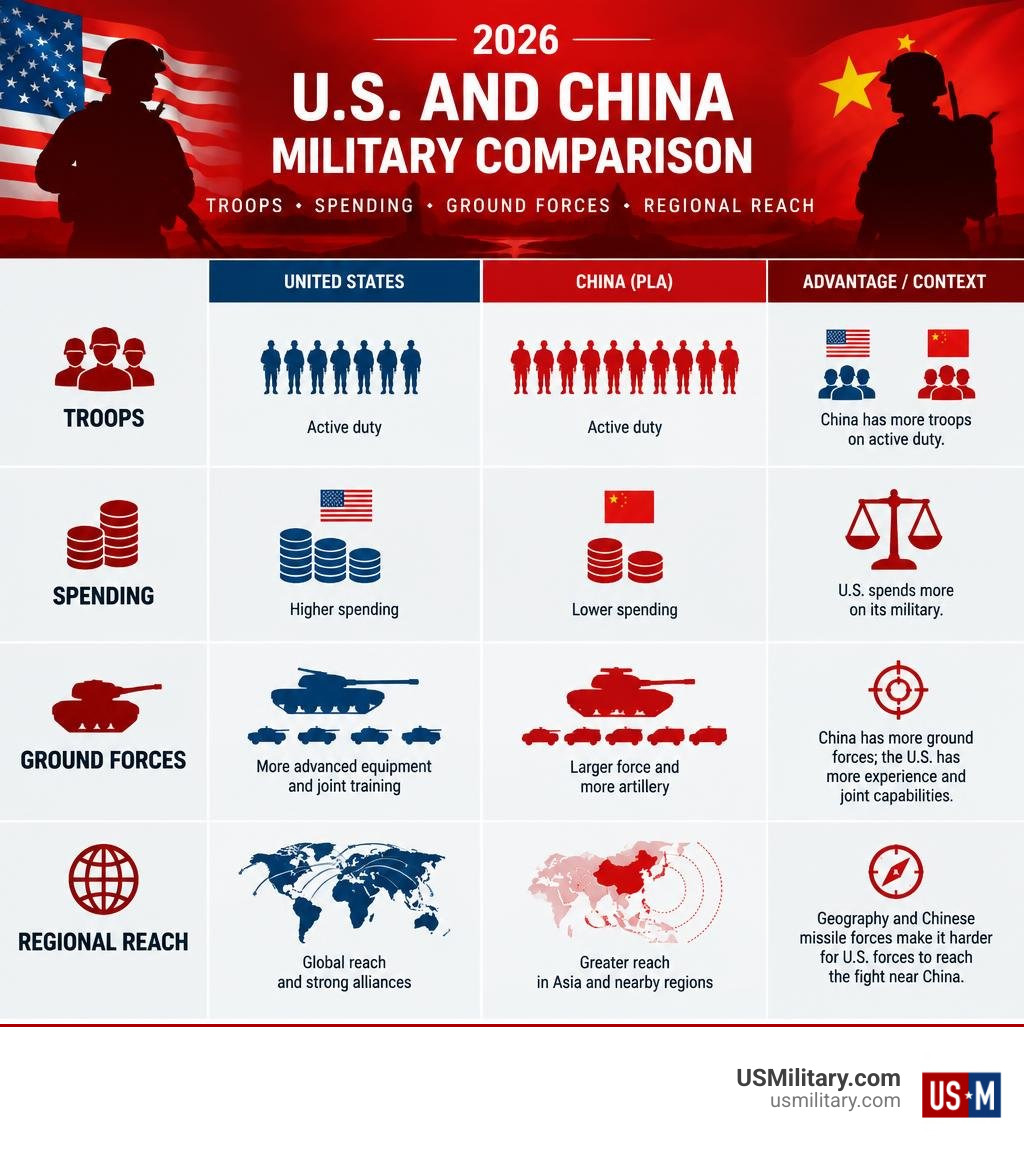
China’s army is larger, but size alone doesn’t determine which force is stronger. The People’s Liberation Army Ground Force has more active troops and a large artillery force. The U.S. Army brings extensive combat experience, strong joint training, and support from allies. In a conflict near China, geography and Chinese missile forces would make it hard for U.S. forces to reach the fight. The outcome would depend as much on air and sea power, supply lines, and political decisions as on ground troops.
I’m Larry Fowler, a Navy veteran, BUD/S Class 89 graduate, and publisher of USMilitary.com. In answering “How Would US Army Compare To China’s Army?”, I’ll use that background to look beyond troop and tank counts.
How Would the US Army Compare To China’s Army Across Core Military Domains?
Evaluating the modern balance between the United States and the People’s Republic of China requires looking across land, sea, air, space, and cyberspace. The table below outlines key conventional benchmarks:
| Military Metric | United States | China (PLA) | Advantage / Context |
|---|---|---|---|
| Annual Defense Budget | ~$831.5B – $920B | ~$281.2B – $303B | U.S. leads in absolute funds; China maximizes purchasing power parity |
| Active Military Personnel | ~1,326,000 | ~2,035,000 | China holds a 1.5:1 manpower edge |
| Main Battle Tanks | 4,666 | 4,770 | Near numerical parity; U.S. Abrams offers combat-proven armor |
| Mobile Rocket Projectors | 1,731 | 2,770 | China leads in ground-based saturation rocket artillery |
| Total Combat Aircraft | 3,002 (13,000+ total) | 2,842 (3,500+ total) | U.S. dominates overall fleet size and 5th-generation stealth volume |
| Naval Warships / Hulls | ~226 – 295 combatants | ~350 – 477 hulls | China leads in total hull count; U.S. leads in tonnage and carriers (11 vs. 3) |
| Submarines | 66 (all nuclear) | 61 (diesel + nuclear) | U.S. maintains significant undersea acoustic stealth advantage |
| Nuclear Warheads | ~5,042 | ~620 | U.S. holds an 8.1:1 strategic deterrent lead |
Understanding these metrics requires looking into how both forces organize, equip, and sustain their personnel across individual operational environments.
Defense Budgets and Troop Manpower: How Would the U.S. Army Compare To China’s Army in Scale?
The Pentagon operates with a massive financial footprint, but evaluating defense spending requires context. While Washington allocates over $800 billion annually, Beijing stretches its estimated $300 billion budget further due to lower labor costs, state-subsidized defense manufacturing, and domestic purchasing power parity.
In terms of overall size, the U.S. maintains about 1.33 million active-duty personnel, supported by roughly 800,000 reserve and National Guard troops. In contrast, the People’s Liberation Army (PLA) fields over 2 million active personnel, with the PLA Ground Force (PLAGF) alone maintaining roughly 975,000 soldiers.
Both nations face demographic shifts and Gen Z recruitment hurdles. The U.S. all-volunteer force contends with high qualification standards and competition from civilian careers, while China’s selective conscription model must navigate single-child generational pressures and rural-to-urban education divides.
Landpower and Maneuver Warfare: How Would the U.S. Army Compare To China’s Army on the Ground?
On the ground, both nations field formidable mechanized units. The U.S. Army relies on modernized M1A2 Abrams main battle tanks, Bradley fighting vehicles, Strykers, and mobile rocket platforms like HIMARS. China responds with Type 99A tanks, advanced infantry fighting vehicles, and 2,770 mobile rocket projectors.
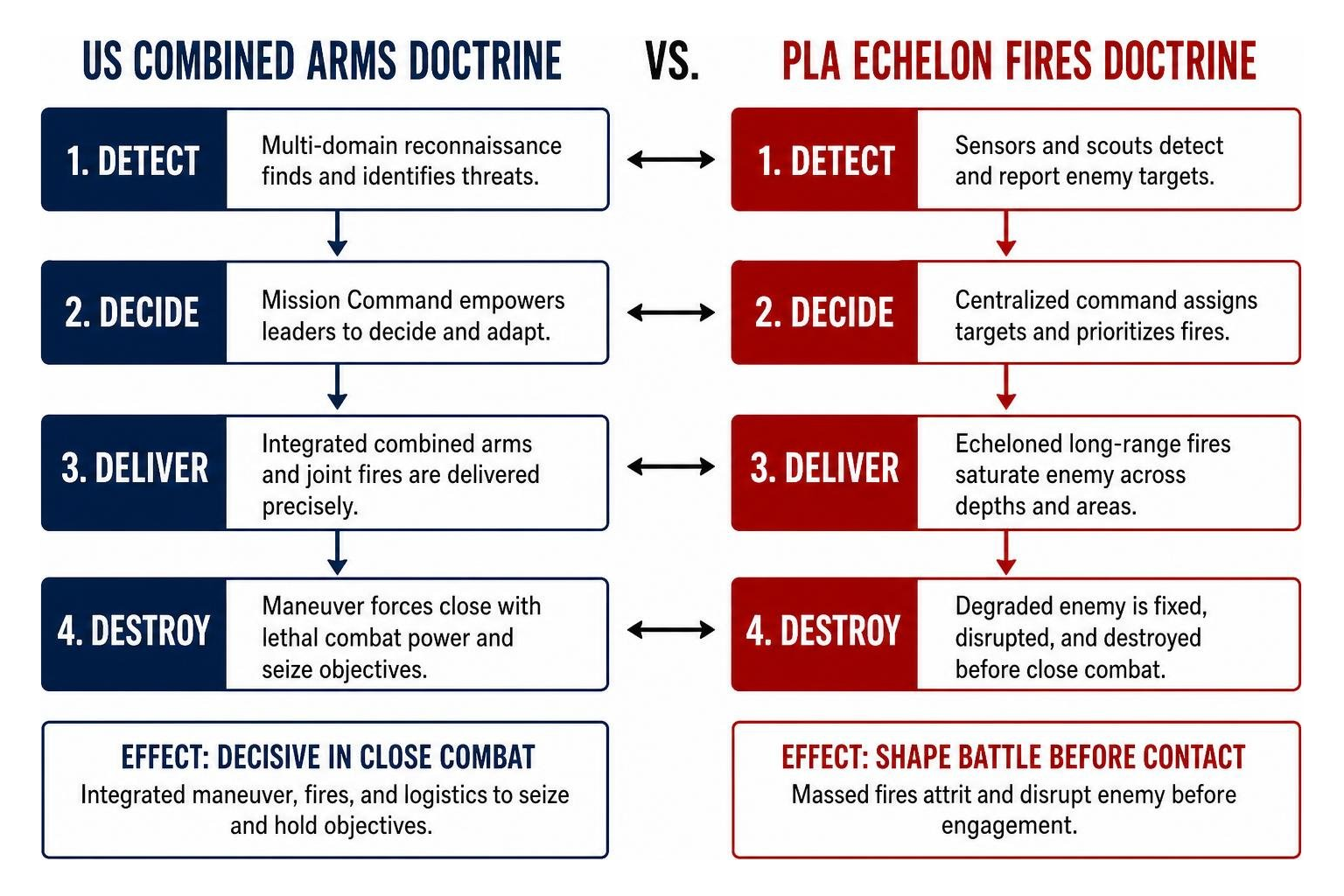
Where the U.S. Army pulls ahead is operational maturity:
- Non-Commissioned Officer (NCO) Corps: American small-unit leaders exercise decentralized initiative under Mission Command, adapting instantly when communications degrade.
- Combined-Arms Integration: Decades of joint operations connect American ground maneuver seamlessly with close air support, naval fires, and tactical logistics.
- Combat-Ready Force Design: Current deployments and equipment highlight a force seasoned by continuous forward deployments, joint exercises, and allied interoperability.
The PLAGF has enacted extensive reforms into combined-arms brigades, but its command culture remains more centralized and untested in modern high-intensity maneuver warfare.
Air Superiority, Undersea Warfare, and Naval Power Projection
In any Pacific scenario, maritime and aerospace power serve as the primary barriers to entry.

The U.S. Navy and Air Force maintain unmatched global reach with 11 nuclear-powered supercarriers and over 3,000 combat aircraft, including the world’s largest operational fleet of 5th-generation stealth fighters (F-22s and F-35s). China’s carrier force is expanding with vessels like the Fujian, but its blue-water carrier aviation doctrine remains in its early operational stages.
Under the waves, America’s submarine fleet—consisting entirely of nuclear-powered fast-attack and ballistic missile boats (SSNs and SSBNs)—retains a decisive acoustic quietness and sensor edge. While China is investing heavily in newer nuclear hulls and large-displacement unmanned undersea vehicles, U.S. anti-submarine warfare (ASW) networks and undersea dominance remain the ultimate deterrent against hostile surface fleets.
Cyber, Space, and Long-Range Missile Strike Capabilities
China’s primary asymmetric advantage lies in its PLA Rocket Force and integrated Anti-Access/Area Denial (A2/AD) network. Beijing fields the world’s largest operational inventory of ground-launched ballistic, cruise, and hypersonic strike weapons. Systems such as the DF-21D and DF-26 “carrier killers” can strike surface combatants and regional airfields out past the First and Second Island Chains, extending operational risk toward Guam.
In orbit and across the digital spectrum, both militaries operate advanced capabilities:
- Space and Counter-Space: Both nations deploy sophisticated satellite constellations for targeting and communications, along with kinetic anti-satellite (ASAT) and directed-energy counter-space weapons.
- Offensive Cyber and EW: China prioritizes electronic jamming to disrupt command-and-control links, while U.S. Cyber Command maintains world-class capabilities to penetrate and neutralize adversarial digital infrastructure.
- Strategic Nuclear Triad: The U.S. maintains a comprehensive nuclear triad of over 5,000 warheads, providing overwhelming strategic deterrence against China’s growing arsenal of roughly 620 warheads.
Strategic Flashpoints, Logistical Vulnerabilities, and War Game Outcomes
A direct conflict between the U.S. and China would not happen in a vacuum—geography, allied cooperation, and supply lines across thousands of miles of open ocean would decide it.
The tyranny of distance in the Indo-Pacific favors China’s homeland defense perimeter. Operating within the First Island Chain allows Beijing to mass land-based air and missile assets against forward-operating adversaries. Conversely, the U.S. relies on long-range airlift, sealift, and secure forward operating bases across Japan, South Korea, the Philippines, and Australia to project power.
Industrial Capacity, Munitions Stockpiles, and Supply Chain Resilience
A prolonged great-power conflict tests industrial endurance more than standing arsenals. China commands massive commercial shipbuilding capacity—bolstered by state-owned mega-yards that outpace U.S. naval construction throughput—allowing Beijing to repair damaged hulls and rapidly produce replacement surface combatants.
Conversely, the American defense industrial base faces narrow bottlenecks in dry dock availability, critical minerals, and stockpiles of precision-guided munitions (such as Long-Range Anti-Ship Missiles and Patriot interceptors).
Key non-kinetic factors that would dictate the outcome of a prolonged campaign include:
- Expeditionary Munition Reserves: Rapidly replenishing standoff anti-ship and air-defense missiles before theater depots run dry.
- Allied Basing Access: Regional treaty allies’ willingness to host strike assets and grant sovereign airspace access under hostile fire.
- Maritime Supply Line Security: Protecting vulnerable logistics hubs, fleet oilers, and cargo transports from submarine and long-range bomber interdiction.
- Domestic Industrial Mobilization: The ability of U.S. commercial manufacturing to transition into rapid wartime production for replacement platforms and microelectronics.
War Game Simulations and Indo-Pacific Conflict Realities
Independent research scorecards and Pentagon simulations evaluating high-intensity scenarios—such as a defense of Taiwan—consistently reveal the brutal reality of modern Pacific warfare. Chinese opening salvos of hypersonic and ballistic missiles would target regional runways, logistics hubs, and surface combatants, creating severe operational friction.
To counter this, U.S. operational doctrine has evolved from centralized base defense toward Agile Combat Employment, Distributed Maritime Operations, and resilient Multi-Domain Task Forces. By dispersing ground-based anti-ship missile units, submarine assets, and stealth aircraft across dispersed island networks, the joint force aims to complicate enemy targeting and deny sea control.
Navigating these modern strategic realities requires understanding how each service branch contributes to national defense. For deeper insights into operational structures, military benefits, or career paths, explore the dedicated guides across USMilitary.com, including our detailed breakdown of the distinct roles across the branches of the military.
Larry Fowler is a Navy BUD/S Class 89 graduate and publisher of NavySeal.com, USArmy.com, and the USMilitary.com Network, which provides clear, authoritative analysis on national defense, service branches, and veteran resources.