
Why Army Standard Height and Weight Rules Matter Before You Enlist
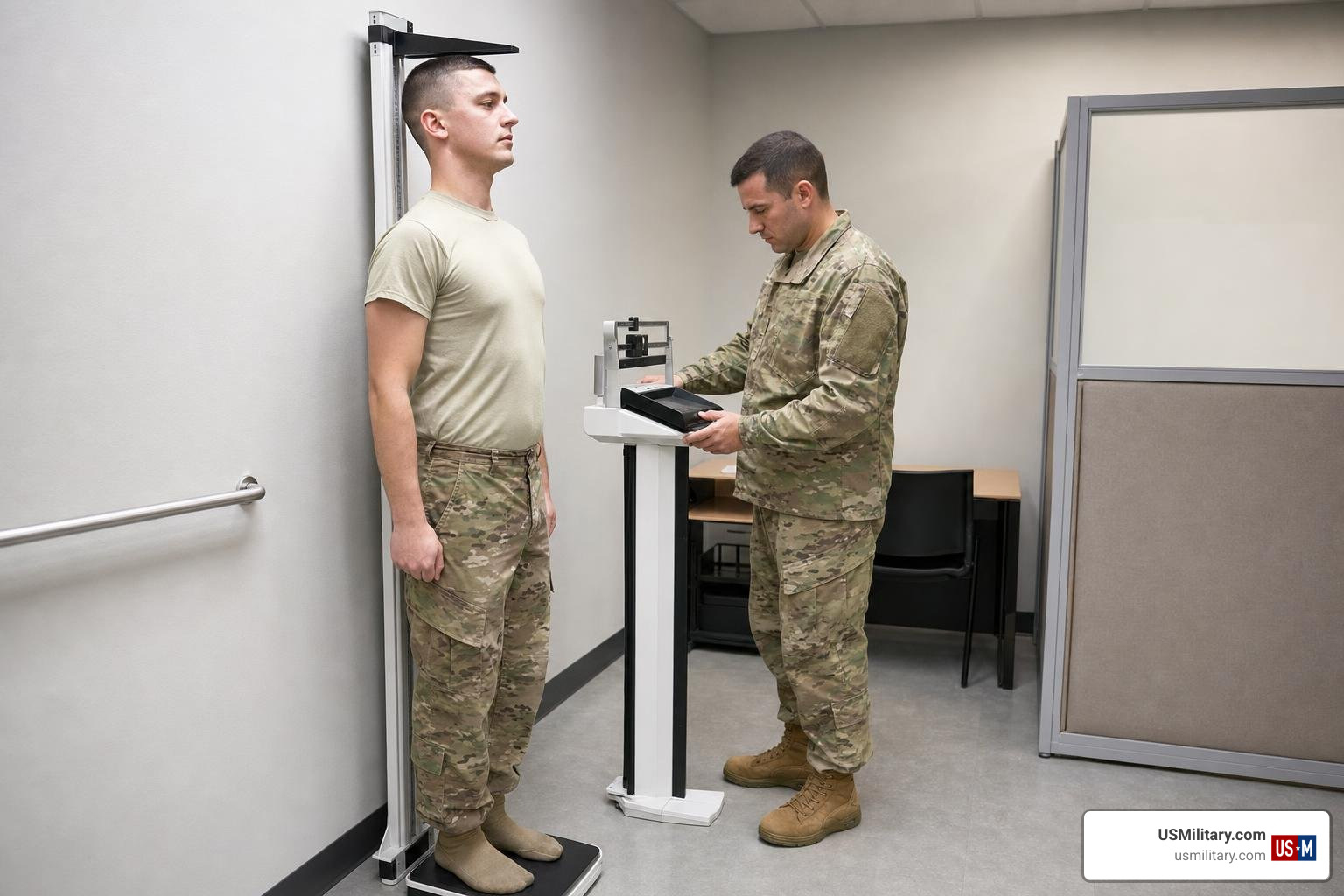
The army standard height and weight requirements are the first physical checkpoint every recruit — and every serving soldier — must pass. Before a push-up is counted or a mile is run, your height and weight are compared against an official table.
Here is a quick snapshot of where the limits stand in 2026:
| Gender | Min. Height | Max. Height | Min. Weight (example: 60 in.) | Max. Weight (example: 60 in., age 17-20) |
|---|---|---|---|---|
| Male | 60 in. | 80 in. | 97 lbs | 132 lbs |
| Female | 58 in. | 80 in. | 91 lbs | 119 lbs |
Key facts at a glance:
- Screening is done at MEPS (Military Entrance Processing Station) and repeated at least every 6 months once you serve.
- If you exceed the weight limit for your height and age, you are not automatically disqualified — you move to a body fat tape test.
- Maximum allowable body fat ranges from 20% (males, age 17-20) to 26% (males, 40+), and 30% (females, 17-20) to 36% (females, 40+).
- Soldiers who score 465 or higher on the Army Fitness Test (AFT) with at least 80 points in each event are exempt from the tape test entirely.
These standards are governed by Army Regulation 600-9 and AR 40-501, and they apply to active duty, reserve, and National Guard soldiers alike.
Understanding exactly where you stand — and what happens if you fall outside the limits — can make or break your path to service.
I’m Larry Fowler, publisher of USMilitary.com, a network I have run since 2007 to help active-duty troops, recruits, and veterans navigate complex military policies, including army standard height and weight requirements. In that time, I’ve helped connect hundreds of thousands of prospective soldiers with the information and recruiters they need to move forward confidently.
Read on for a full breakdown of the screening tables, the tape test process, exemptions, and what to do if you do not yet meet the standards.
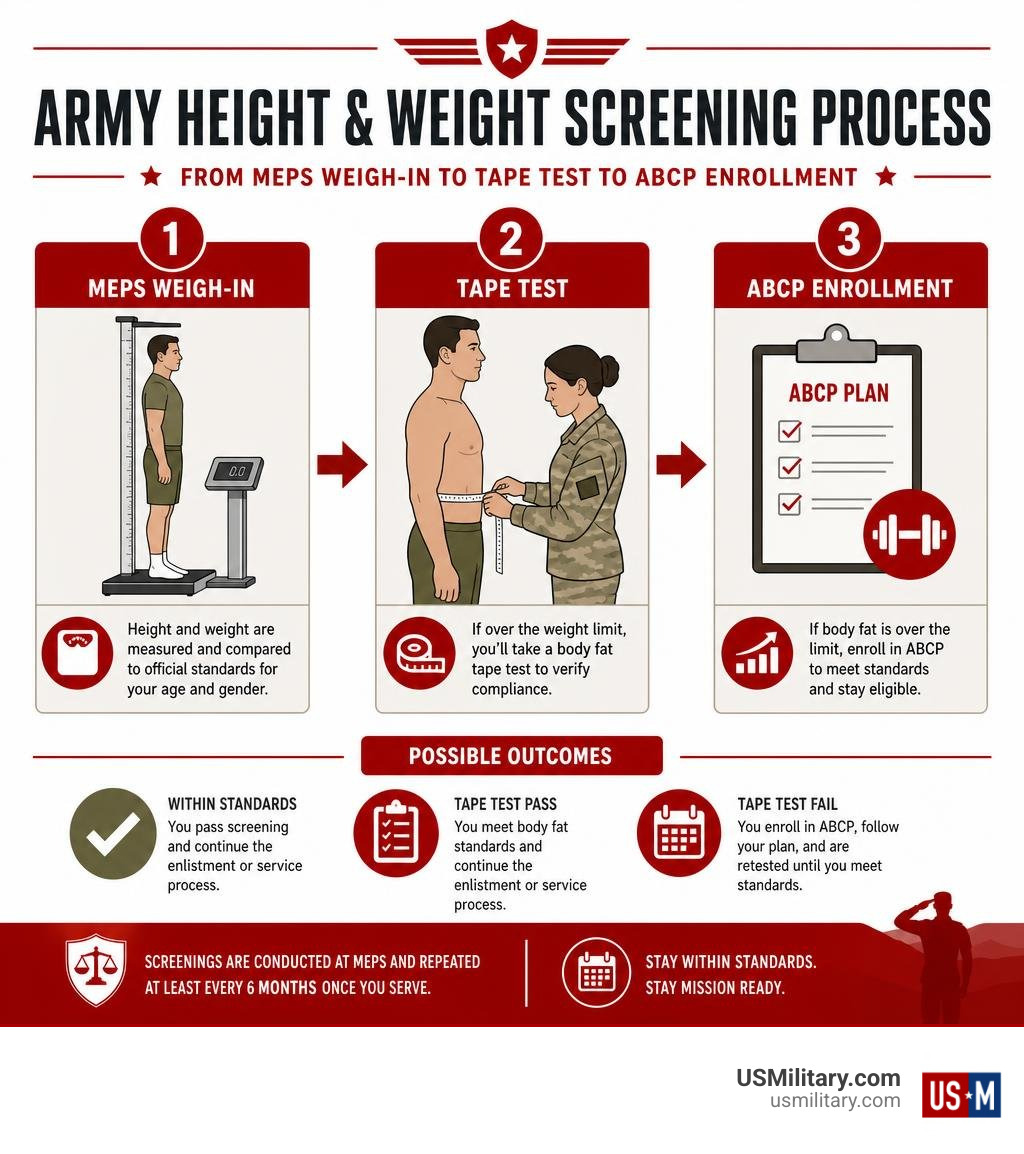
Understanding the Army Standard Height and Weight Requirements
At USMilitary.com, we know that looking at military regulations can feel like reading a foreign language. But maintaining the army standard height and weight is about more than looking sharp in uniform. The Department of Defense designs these rules to prevent injuries, ensure operational readiness, and make sure every soldier has the physical stamina to perform under combat conditions.
The two primary regulations governing these standards are AR 600-9 (The Army Body Composition Program) and AR 40-501 (Standards of Medical Fitness).
When you first apply to join, your journey begins at the Military Entrance Processing Station (MEPS). Here, medical staff will measure your height and weight in stocking feet. Height is rounded to the nearest inch, and weight is recorded to the nearest pound in your physical training (PT) uniform with no shoes.
These entry-level measurements apply to everyone: initial entry recruits, active duty, reserve components, and officer candidates. If you fall within the acceptable ranges on the screening tables, you are good to go. If you exceed the screening weight, you do not get sent home immediately. Instead, the Army uses a two-step process, moving you to a body fat evaluation to see if your extra weight is muscle or fat.
To understand the broader context of these physical benchmarks, you can read our comprehensive guide on Army Height and Weight Standards.
Male Army Standard Height and Weight Screening Tables
For men, the screening tables are divided by height (ranging from 60 to 80 inches) and broken down into four distinct age brackets. As soldiers age, the maximum allowable weight increases slightly to account for natural changes in metabolism and body composition.
To give you an idea of how these age brackets affect your maximum weight, let us look at a few examples:
- Height: 68 inches (5’8″)
- Minimum Weight: 132 lbs
- Max Weight (Age 17-20): 178 lbs
- Max Weight (Age 21-27): 180 lbs
- Max Weight (Age 28-39): 182 lbs
- Max Weight (Age 40+): 185 lbs
- Height: 72 inches (6’0″)
- Minimum Weight: 148 lbs
- Max Weight (Age 17-20): 200 lbs
- Max Weight (Age 21-27): 202 lbs
- Max Weight (Age 28-39): 204 lbs
- Max Weight (Age 40+): 208 lbs
If you are a young recruit planning your future enlistment, it is helpful to look at how age impacts your eligibility. Learn more about how age affects your entry process in our detailed resource, Your Age and the Army.
Below is a reference table comparing male and female maximum screening weights for common heights across the youngest age bracket (17-20):
| Height (Inches) | Male Min. Weight (lbs) | Male Max. Weight (lbs) | Female Min. Weight (lbs) | Female Max. Weight (lbs) |
|---|---|---|---|---|
| 60 | 97 | 139 | 91 | 122 |
| 64 | 114 | 158 | 105 | 139 |
| 68 | 132 | 178 | 120 | 158 |
| 72 | 148 | 200 | 136 | 178 |
| 76 | 166 | 223 | 152 | 199 |
Female Army Standard Height and Weight Screening Tables
The screening standards for female soldiers are also structured around age and height, starting at a minimum height of 58 inches. Just like the male tables, the maximum weight limits scale upward as you age.
Let us look at some common height and weight limits for female soldiers:
- Height: 64 inches (5’4″)
- Minimum Weight: 105 lbs
- Max Weight (Age 17-20): 139 lbs
- Max Weight (Age 21-27): 141 lbs
- Max Weight (Age 28-39): 143 lbs
- Max Weight (Age 40+): 145 lbs
- Height: 68 inches (5’8″)
- Minimum Weight: 120 lbs
- Max Weight (Age 17-20): 158 lbs
- Max Weight (Age 21-27): 160 lbs
- Max Weight (Age 28-39): 162 lbs
- Max Weight (Age 40+): 165 lbs
The Army recognizes that female soldiers have unique physiological needs. Because of this, there is a clear pregnancy exemption. Pregnant soldiers are completely exempt from body composition standards for the duration of their pregnancy.
Furthermore, the postpartum standard gives new mothers a generous buffer of 180 days after giving birth to recover and meet the standard retention requirements. If you want to dive deeper into these specific charts and guidelines for women, check out Army Height and Weight Standards 2.
How the Army Body Composition Program (ABCP) Works
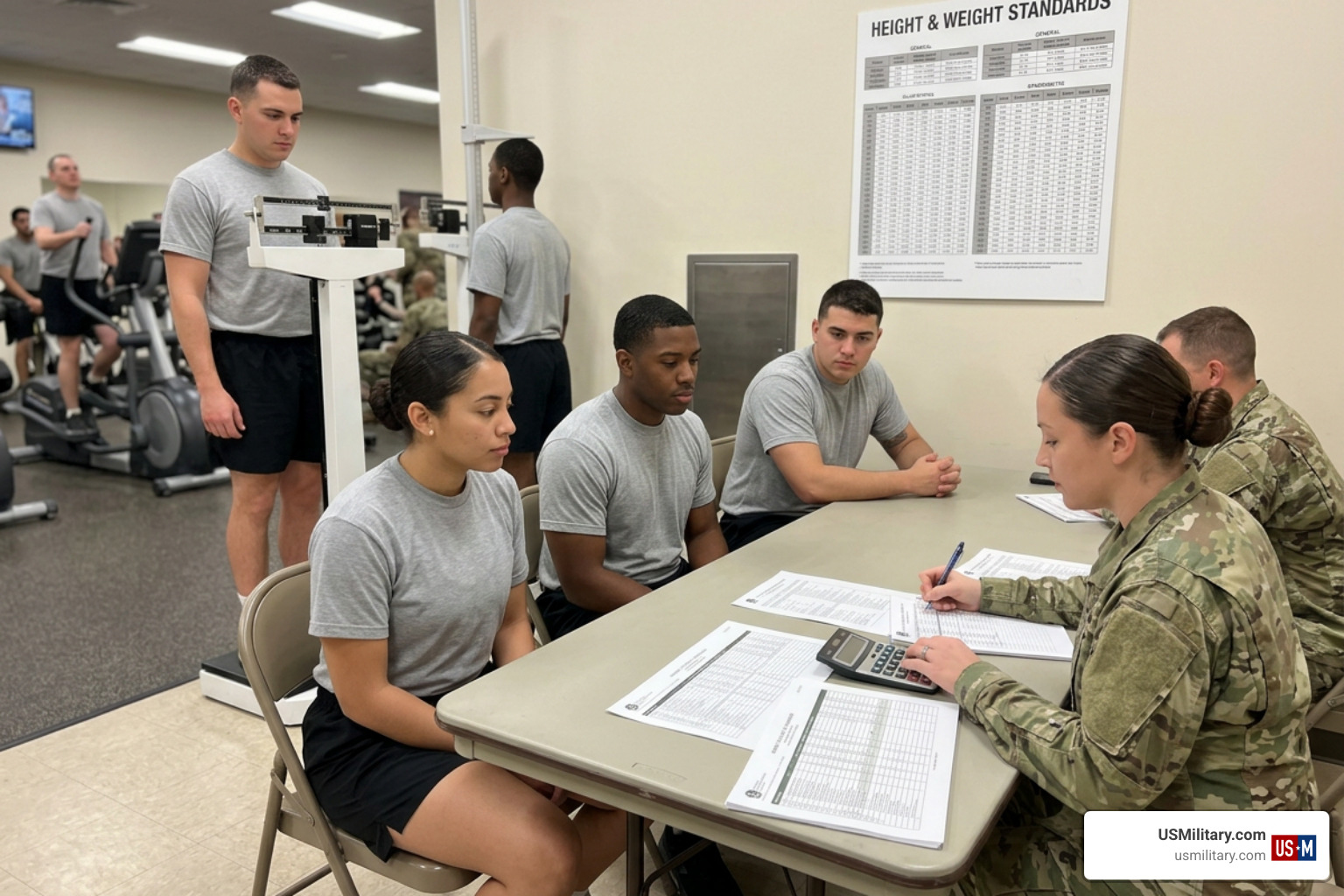
If you step onto the scale during a semi-annual weigh-in and find yourself over the maximum screening weight, do not panic. This is where the Army Body Composition Program (ABCP) comes into play. The scale only tells part of the story; it cannot differentiate between 200 pounds of muscle and 200 pounds of fat.
When a soldier exceeds the screening table weight, they are referred for a body fat assessment, commonly known as the “tape test.” If this assessment reveals that you exceed the maximum allowable body fat percentage for your age and gender, you will be enrolled in the ABCP.
Enrollment is a formal process. The commander must flag the soldier’s record within 3 working days and provide official counseling within 2 working days of the flag. Once enrolled, the soldier has 14 days to submit a Soldier Action Plan detailing their diet and exercise goals, and 30 days to complete mandatory nutritional counseling with a registered dietitian or healthcare provider.
While enrolled, you must show “satisfactory progress.” The Army defines this as a monthly loss of 3 to 8 pounds, or a 1% reduction in body fat. If a soldier fails to make satisfactory progress for 3 nonconsecutive months, they face program failure, which can lead to administrative separation from the service. You can read the official regulation details in The Army Body Composition Program PDF.
The One-Site Tape Test and Body Fat Standards
In June 2023, the Army updated its body fat assessment policy to make the tape test more accurate and simpler to administer. The previous multi-site tape test (which measured the neck and abdomen for men, and the neck, waist, and hips for women) was phased out.
Today, the standard is the One-Site Tape Test. This test measures the abdominal circumference at the navel (belly button) for both men and women.
Under the current rules, the Army uses a Waist-to-Height Ratio (WHtR) screening. If your waist circumference divided by your height yields a ratio of less than 0.55, you pass the screening immediately, regardless of what the scale says.
If you do not pass the WHtR screening, your body fat is calculated using standard circumference formulas. The maximum allowable body fat percentages are strictly enforced by age group:
- Ages 17-20: 20% for males / 30% for females
- Ages 21-27: 22% for males / 32% for females
- Ages 28-39: 24% for males / 34% for females
- Ages 40+: 26% for males / 36% for females
Supplemental Body Fat Assessments
We know that no tape test is 100% perfect. Highly muscular soldiers — such as heavy weightlifters or powerlifters — sometimes have thick waists that can trigger a false positive on a tape test.
Fortunately, current policies protect fit soldiers. If you fail the one-site tape test, you have the right to request a supplemental body fat assessment using advanced, highly accurate medical technologies. These include:
- DXA (Dual-Energy X-Ray Absorptiometry): Uses safe, low-power X-ray beams to separate bone mineral, lean mass, and fat mass.
- InBody 770: A multi-frequency bioelectrical impedance analysis device that measures body water and fat levels.
- Bod Pod: Uses air displacement plethysmography to measure body volume and density with an error margin of just +/- 2.7%.
If you pass any of these supplemental assessments, you are considered within standards and will not be enrolled in the ABCP. This policy ensures that heavily muscled soldiers are not unfairly penalized for their strength.
Exemptions and the High AFT Performance Exemption
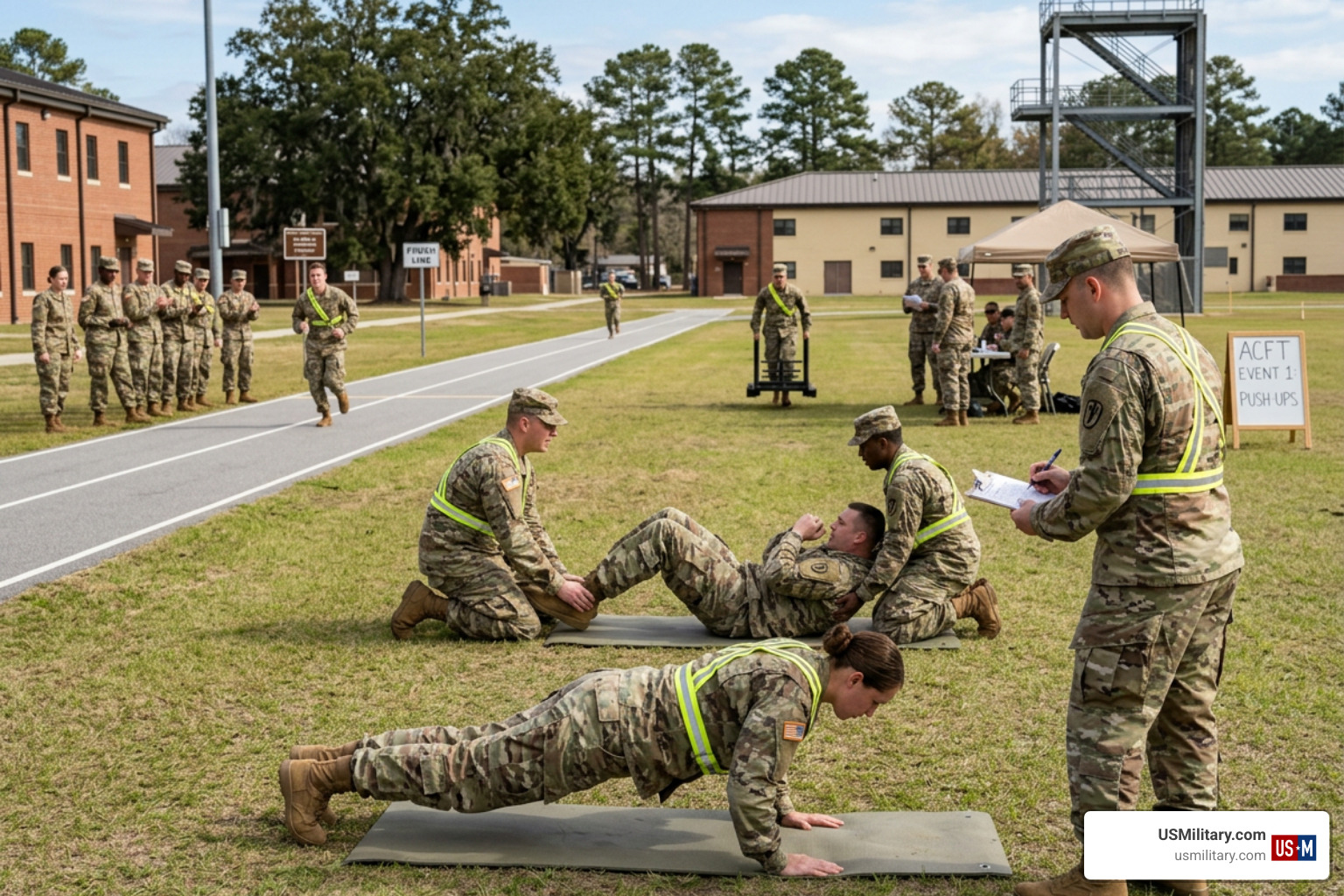
Not every soldier who exceeds the weight on the screening table has to grab the measuring tape. The Army provides several common-sense exemptions to the ABCP:
- Soldiers with major limb loss: Amputees who have lost a limb above the ankle or wrist are exempt, provided they maintain a professional military appearance.
- Hospitalized soldiers: Anyone with 30 or more continuous days of hospitalization is exempt.
- Pregnant and postpartum soldiers: As mentioned, this exemption covers the entire pregnancy plus 180 days postpartum.
The most exciting update in recent years is the High AFT Performance Exemption (established under Army Directive 2025-17, which went into effect in September 2025 and remains fully active).
Under this policy, any soldier who achieves an Army Fitness Test (AFT) score of 465 points or higher — with a minimum score of 80 points in each of the six events — is completely exempt from the tape test and ABCP enrollment. It does not matter what the scale says or how wide your waist is; if you can perform at this elite level, the Army recognizes you as physically fit for duty.
Preparing your body to meet these elite fitness scores starts early. You can learn about what to expect during your initial training by reading about Army Basic Training Requirements.
Consequences of Failing to Meet Army Body Composition Standards
What happens if you simply cannot meet the army standard height and weight limits, and you fail the tape test and supplemental assessments? The consequences for your military career are significant.
First, your records will be flagged administratively using a DA Form 268. This flag restricts several key career milestones:
- You are non-promotable and cannot be advanced in rank.
- You cannot be assigned to command positions.
- You are barred from attending professional military schools (such as PLC or Advanced Leader Courses).
- You cannot receive military awards or decorations.
If a soldier is enrolled in the ABCP and fails to show satisfactory progress for 3 nonconsecutive months (or fails to meet the standard after 12 months in the program), the commander is required to initiate administrative separation from the Army.
For new recruits who are struggling with their weight before shipping out, the Army has created an incredible resource: the Future Soldier Preparatory Course (FSPC). Located at Fort Jackson, South Carolina, this 90-day pre-basic training track allows recruits to enlist with up to 6% more body fat than normally allowed.
At the FSPC, trainees learn about portion control, healthy sleep habits, active recovery, and structured exercise. On average, recruits in this program lose 1.5% body fat per week, helping them safely transition into standard training. You can read more about how this integrates with your first weeks in the military by checking out Army Basic Training.
Frequently Asked Questions about Army Body Composition
How often are soldiers required to be weighed and measured?
Active duty and reserve soldiers must be screened at least once every 6 months. However, commanders have the authority to direct a body fat assessment at any time if a soldier’s physical appearance suggests they may exceed the body fat standards, even if their weight is within the screening table limits.
What happens if a recruit exceeds the weight limit before basic training?
If you exceed the weight limit at MEPS, your recruiter can help you apply for the Future Soldier Preparatory Course fitness track. This course gives you up to 90 days of professional coaching to get your body composition within regulations before you start basic training. If you are ready to take the first step and speak with a professional about your options, you can easily find an Army Recruiter Near Me.
Are there height requirements for initial entry and officer candidates?
Yes. For initial entry enlistment, the height range for both men and women is 58 to 80 inches (though men must be at least 60 inches at MEPS unless they receive a waiver). For officer candidates, the minimum height requirements are slightly lower: 58 inches for men and 56 inches for women. You can view the full list of entry criteria directly on the official Eligibility & Requirements to Join page.
Conclusion
Meeting the army standard height and weight is a vital part of being a professional soldier. Whether you are a high school senior preparing for MEPS or an active-duty soldier aiming for a promotion, staying within these guidelines ensures you are always ready to answer the call of duty.
At USMilitary.com, we are dedicated to supporting our service members, veterans, and future recruits with trusted, unbiased information. From understanding your physical requirements to exploring VA home loans, military retirement, and career paths across all branches, we serve as your central hub for military life.
If you want to track your fitness goals and make sure you are fully prepared for your next weigh-in, explore our official resource on Army Weight Standards to keep your career moving forward.