
Understanding VA Math and the Whole Person Theory

When soldiers transition out of the Army, they often assume calculating their Department of Veterans Affairs (VA) rating works like regular arithmetic. If an Army veteran receives a 50% rating for post-traumatic stress disorder (PTSD), 30% for a lumbar spine injury from carrying heavy rucks, and 10% for combat-related tinnitus, simple math says 50 + 30 + 10 = 90%.
Under the VA’s system, that same veteran receives a 70% combined rating.
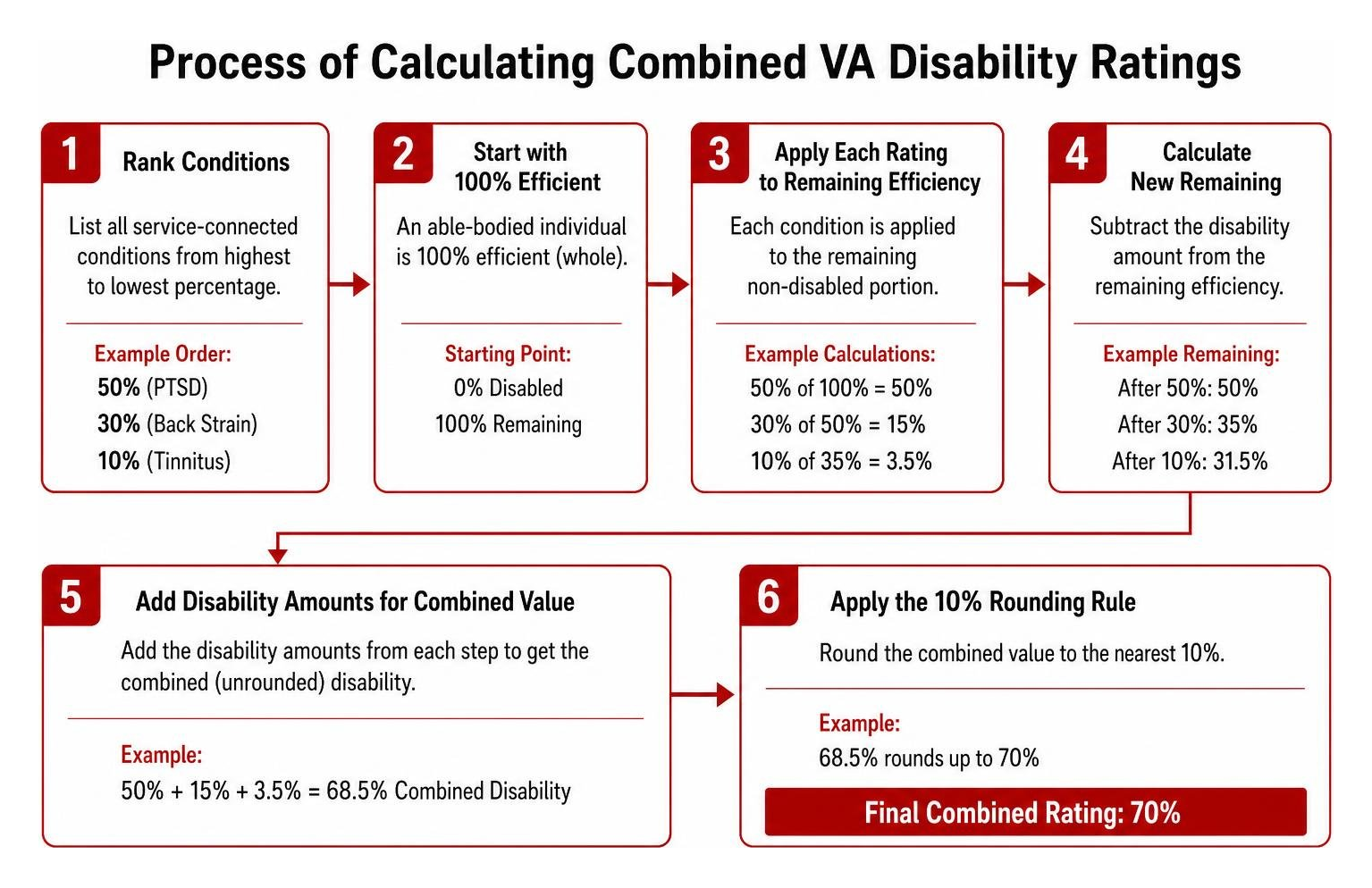
The VA does not add disability percentages together. Instead, the agency uses a non-additive calculation based on the “Whole Person Theory” (also known as the descending efficiency model). The VA views an able-bodied individual entering service as 100% efficient or whole. When you suffer a service-connected disability, that percentage reduces your initial 100% efficiency. Every subsequent condition can only reduce the remaining, non-disabled portion of your body. Our comprehensive VA Disability Rating Chart Guide 2026 explains how these matrix intersections dictate your overall standing.
| Condition Sequence | Individual Rating | Linear Addition | VA Efficiency Calculation | Remaining Non-Disabled Body |
|---|---|---|---|---|
| Initial Baseline | 0% | 0% | 0% Disabled | 100% Whole |
| Condition 1 (e.g., PTSD) | 50% | 50% | 50% of 100% = 50% Disabled | 50% Remaining |
| Condition 2 (e.g., Back Strain) | 30% | 80% | 30% of 50% = 15% Disabled | 35% Remaining (Combined: 65%) |
| Condition 3 (e.g., Tinnitus) | 10% | 90% | 10% of 35% = 3.5% Disabled | 31.5% Remaining (Combined: 68.5%) |
| Final Rounded Rating | — | 90% | 68.5% rounds up to 70% | 70% Final Rating |
Why Army Veterans Cannot Just Add Disability Percentages
The VA caps total disability at 100% because a human being cannot be more than 100% disabled under standard rating tables. As your rating increases, reaching the next percentage tier requires significantly more medical evidence and higher individual ratings because your remaining non-disabled percentage is smaller.
This diminishing efficiency dynamic becomes critical for pre-existing medical conditions aggravated by military service. When an Army recruit enters basic training with a documented pre-service condition rated at 10%, and service aggravates that condition to 20%, the VA compensates only for the “level of aggravation” (20% minus 10% = 10% compensable rating). A reliable calculator must account for these non-linear reductions so you don’t build financial plans around inflated estimates.
Step-by-Step Combined Ratings and the 10 Percent Rounding Rule
To manually calculate your combined rating or verify what an automated tool generates, follow the VA’s structured process:
- Rank All Conditions: List all service-connected conditions in descending order from highest to lowest percentage.
- Calculate the First Intersect: Take the highest condition percentage and subtract it from 100% efficiency.
- Apply Subsequent Conditions Sequentially: Take the next highest rating and calculate that percentage of the remaining efficiency. Add this result to the previous total.
- Maintain Non-Rounded Values: Never round intermediate scores. Keep exact decimal figures until all conditions are incorporated.
- Apply the 10% Rounding Rule: Once all conditions are combined, round the final number to the nearest 10%. Numbers ending in 1% through 4% round down (e.g., 64% rounds down to 60%), while numbers ending in 5% through 9% round up (e.g., 65% rounds up to 70%).
When preparing for your formal VA Disability Evaluation, understanding these rounding thresholds helps you identify how close you are to the next pay bracket.
Features of the Best VA Disability Calculator for Army Veterans
An effective estimation tool does far more than execute basic subtraction. High-performance tools like our 2026 VA Disability Calculator automate complex VA regulations, save hours of manual matrix cross-referencing, and eliminate costly mathematical errors.
When comparing online tools, the Army Va Disability Calculator – calculatorgek and similar resources provide helpful baseline logic, but the best calculators must integrate specific features:
- Automatic Sorting: The tool should order your ratings from highest to lowest automatically, regardless of the sequence you enter.
- Bilateral Factor Toggles: It must let you specify whether an extremity injury affects the left side, right side, or both, applying the mandatory bilateral multiplier.
- Granular Dependency Fields: It must calculate accurate additions for spouses, minor children, college students aged 18 to 23, and dependent parents.
- Up-to-Date Pay Schedules: It must draw from active cost-of-living adjustments (COLA) to display real monthly tax-free compensation figures.
Key Inputs Required for the Best VA Disability Calculator for Army Veterans
To get the most accurate results from an Army disability calculator, gather your documents and enter the following details:
- Individual Disability Ratings: The official percentage assigned to each primary and secondary condition (from 0% to 100%).
- Extremity Designations: Identifying whether musculoskeletal, nerve, or vascular conditions affect paired arms or legs.
- Marital Status: Indicating if you are single, married, or surviving.
- Dependent Children Under 18: The exact count of minor children in your household.
- Adult Student Dependents: Children between ages 18 and 23 attending an approved secondary school, college, or vocational program.
- Dependent Parents: Qualifying biological, adoptive, or foster parents financially dependent on you.
- Special Living Allowances: Indicating if your spouse requires Aid and Attendance (A/A) assistance for daily living activities.
How the Bilateral Factor Impacts Paired Extremity Calculations
The bilateral factor is one of the most misunderstood rules in VA math. Under 38 CFR § 4.26, if you have service-connected disabilities affecting paired extremities (both arms, both legs, or paired skeletal muscles), the VA combines those specific ratings first, adds a 10% boost of that combined value, and then folds the boosted figure back into your overall rating.
For example, suppose an Army paratrooper has:
- 20% right knee condition
- 10% left ankle condition
- 30% lower back strain
The calculator first combines the paired lower extremities: 20% combined with 10% equals 28%. Next, it adds 10% of 28% (2.8%), bringing the bilateral subtotal to 30.8%.
Finally, it combines the 30.8% bilateral value with the 30% back strain:
- Remaining efficiency: $100\% – 30.8\% = 69.2\%$
- Back condition impact: $30\% \times 69.2\% = 20.76\%$
- Combined total: $30.8\% + 20.76\% = 51.56\%$
Without the bilateral factor, the standard combined value would be 49.6% (rounding down to 50%). With the bilateral factor, 51.56% rounds up to a 50% rating (and sits much closer to bumping into 60% with any minor secondary condition). In many borderline rating profiles, the bilateral factor is the deciding element that pushes a veteran into a higher compensation bracket.
2026 VA Disability Compensation Rates and Dependent Tiers
The VA adjusts monthly tax-free compensation rates each year based on Social Security cost-of-living adjustments (COLA). For official payment schedules, review the Current Veterans Disability Compensation Rates published by the VA.
Our updated VA Disability Pay Chart 2026 outlines the baseline monthly amounts across all rating percentages.
Baseline Monthly Pay Rates for 10 to 100 Percent Ratings
The 2026 baseline monthly payouts for a veteran with no dependents are:
- 10% Disability Rating: $180.42
- 20% Disability Rating: $356.66
- 30% Disability Rating: $552.47
- 40% Disability Rating: $795.84
- 50% Disability Rating: $1,132.90
- 60% Disability Rating: $1,435.02
- 70% Disability Rating: $1,808.45
- 80% Disability Rating: $2,102.15
- 90% Disability Rating: $2,362.30
- 100% Disability Rating: $3,938.58
For a deeper breakdown of how these tiers scale, read our resource on 2026 VA Disability Rates Everything You Need to Know.
Adding Qualifying Dependents and Aid and Attendance Allowances
Veterans with combined ratings of 10% or 20% receive a flat rate; federal law does not provide additional allowances for dependents at these levels. However, once you reach a 30% combined rating or higher, you become eligible for monthly dependent compensation add-ons.
To see how these numbers add up in practice, look at a veteran rated at 70%:
- Veteran Alone: $1,808.45
- Veteran with Spouse (No Children): $1,971.45
- Veteran with Spouse and 1 Child Under 18: $2,074.45
- Each Additional Child Under 18: +$76.00/month
- Each Additional Child Over 18 in Qualifying School: +$246.00/month
- Spouse Aid and Attendance Allowance: +$141.00/month
A 70% disabled Army veteran with a spouse, three minor children, and a spouse requiring Aid and Attendance calculates their monthly compensation as:
$$\$2,074.45 \text{ (Base with spouse and 1 child)} + \$76.00 + \$76.00 + \$141.00 = \mathbf{\$2,367.45 \text{ per month}}$$
At the 100% rating level, a veteran with a spouse receives $4,158.17 per month, with spousal Aid and Attendance adding $201.41 per month.
Strategies to Increase Your VA Disability Rating Beyond Calculator Estimates
If your calculator results show a combined rating that falls short of your daily health challenges and occupational impairment, several administrative pathways can help you secure an increase.

Knowing How to Increase VA Disability Rating requires understanding how the VA evaluates worsening medical conditions and reviews supplemental medical evidence.
Secondary Service Connections and Common Army MOS Claims
Many Army veterans focus solely on conditions directly caused by combat or training incidents (primary service connections). However, secondary service connections—conditions caused or aggravated by an already service-connected disability—offer a major pathway to an accurate combined rating.
Common secondary claims for Army veterans include:
- Radiculopathy Secondary to Lumbar Spine Strain: Nerve pain radiating down one or both legs caused by service-connected back injuries.
- Depression or Anxiety Secondary to Chronic Pain: Mental health conditions stemming from long-term mobility loss and physical suffering.
- Gastroesophageal Reflux Disease (GERD) Secondary to NSAID Use: Severe stomach issues caused by daily pain medications prescribed for service-connected orthopedic damage.
- Sleep Apnea Secondary to PTSD or Chronic Rhinitis: Airway obstruction aggravated by mental health conditions or service-connected respiratory damage from burn pits.
To explore the full range of eligible diagnoses, check our guide on What Conditions Qualify for Veteran Disability Benefits.
Using an Army VA Disability Calculator to Plan Appeals and TDIU
When service-connected conditions prevent you from maintaining substantially gainful employment, you may qualify for Total Disability Individual Unemployability (TDIU). TDIU pays veterans at the 100% disability compensation rate even if their combined rating is below 100%.
Under standard schedular TDIU requirements (38 CFR § 4.16a), you must have:
- One single service-connected condition rated at 60% or higher, OR
- A combined rating of 70% or higher, with at least one individual condition rated at 40% or higher.
You can use a VA disability calculator to evaluate whether your current ratings meet the schedular TDIU thresholds. If you fall short, the calculator shows which secondary conditions or rating increases would push your total past the 70% mark, giving you a clear roadmap for your supplemental claim or Board of Veterans’ Appeals (BVA) filing.
Frequently Asked Questions About Army VA Disability Calculations
How does the bilateral factor boost an Army veteran’s combined rating?
The bilateral factor provides an extra 10% boost to conditions affecting paired limbs (such as both knees, both shoulders, or bilateral foot conditions). The VA combines the ratings of the paired extremities first using standard VA math, takes 10% of that combined subtotal, adds it to the subtotal, and then combines that boosted score with your remaining non-bilateral disabilities. This boost frequently adds enough points to cross a 10% rounding threshold.
Do dependents increase monthly compensation at 10% or 20% ratings?
No. Federal law mandates flat-rate compensation for veterans rated at 10% ($180.42) and 20% ($356.66). The VA only adds dependent allowances for spouses, children, and dependent parents once a veteran reaches a combined rating of 30% or higher.
Can an online VA disability calculator guarantee an exact monthly payout?
No online calculator can guarantee an exact payout or claim decision. Calculators provide highly accurate mathematical estimates based on VA rating formulas and current compensation tables, but your official rating and payment depend on formal adjudication by the VA, verified medical evidence, Compensation and Pension (C&P) exam findings, and your official dependent documentation.
Conclusion
Navigating the VA rating system requires understanding non-additive VA math, the bilateral factor, and dependent compensation tiers. Estimating your combined rating through a reliable tool gives you the insight needed to review decision letters, plan supplemental claims, and make sound financial decisions for your family.
Explore our detailed VA disability pay tables to review full compensation rates, compare benefit scenarios, and access the tools you need to secure the full disability compensation you earned in service to our nation.